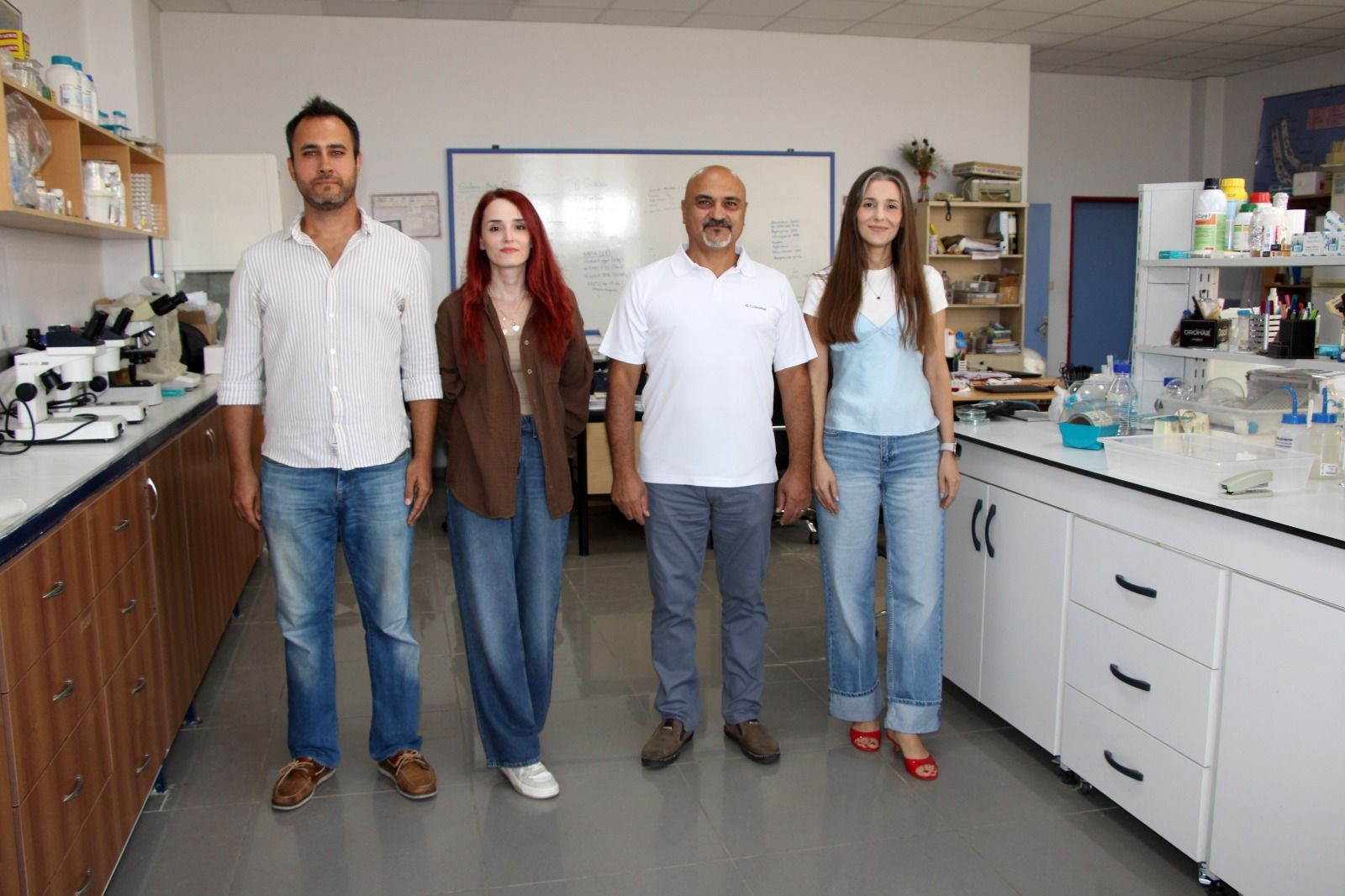
Research Involving ADU Faculty Members Honored with the “Breakthrough of 2026” Award on the International Stage
A collaborative study between our university’s faculty members and scientists at the Max Planck Institute for Terrestrial Microbiology in Germany has achieved a significant international success. The research, which reveals the biological effects of the RXP (Rhabdopeptide) molecule produced by bacteria found in nematodes, was honored with the “Highlight of the Year 2026” award by the Society for Invertebrate Pathology (SIP).
The study, titled “The mystery of the scavenger deterrent factor produced by Xenorhabdus and Photorhabdus bacteria has been solved,” was honored at the 58th meeting of the Society for Invertebrate Pathology, held in ’s-Hertogenbosch, the Netherlands. Prof. Dr. Selçuk Hazır, a faculty member in the Department of Biology at the Faculty of Science, accepted the award on behalf of the research team.
The research team included Prof. Dr. Selçuk Hazır from ADU, Assoc. Prof. Dr. Harun Çimen from Koçarlı Vocational School, Dr. Şebnem Hazal Gülşen, and Assoc. Prof. Dr. Derya Uluğ from the Department of Biology, Faculty of Science. Conducted in collaboration with TÜBİTAK-BMBF, the study involved international scientific cooperation with Prof. Dr. Helge Bode and his team from the Max Planck Institute in Germany.
The Molecular Basis of a Nearly 40-Year-Old Scientific Mystery Has Been Uncovered
The research shed light on the mechanism underlying why the carcasses of insects killed by entomopathogenic nematodes are avoided by a wide variety of organisms, including ants, wild bees, flies, snails, fish, birds, and mice.
The researchers determined that this behavior—which had remained unexplained for nearly 40 years—is caused by the RXP (Rhabdopeptide) molecule produced by the symbiotic bacteria Xenorhabdus and Photorhabdus, which live within the nematodes. As part of the study, the molecule’s chemical structure, synthesis process, and biological properties were examined in detail, and its repellent effect on various groups of organisms was determined.
Found to Be 100 Times More Effective Than DEET
One of the study’s notable findings was that the RXP molecule exhibited a repellent effect approximately 100 times greater than that of the widely used insect repellent DEET (N,N-diethyl-m-toluamide). In experiments conducted using synthetically produced RXP, it was found to be effective against disease-carrying vectors such as mosquitoes and ticks.
Unlike DEET, the RXP molecule has also been found to be effective against agricultural pests. It is expected to offer new applications in the control of disease-carrying vectors that threaten human and animal health, as well as in repelling harmful insects in agricultural production. While research on the synthetic production of the molecule and its various applications continues, an international patent application has also been filed for the discovery.
Our Rector, Prof. Dr. Bülent Kent, received Prof. Dr. Selçuk Hazır, a faculty member of the Department of Biology in the Faculty of Science who accepted the award on behalf of our university for the work recognized with an international award, in his office.
Congratulating Prof. Dr. Selçuk Hazır on this achievement, Rector Prof. Dr. Bülent Kent, also commended all the faculty members who contributed to the research. Emphasizing the importance of our university’s faculty members participating in scientific studies that garner international attention, our Rector, Prof. Dr. Bülent Kent, stated that such achievements make significant contributions to ADÜ’s scientific output and international visibility.